What If Art Was Carved in Stone and Scattered Across a Remote Island?
Imagine standing on a windswept volcanic island in the middle of the Pacific, where every hillside and shoreline whispers stories through stone. Easter Island isn’t just about moai statues—it’s a living art space shaped by centuries of culture, isolation, and creativity. I went not just to see the carvings, but to feel them. What I found was unexpected: an open-air gallery where nature, history, and human expression merge in breathtaking harmony. This is exploration at its most profound.
The Island as an Open-Air Museum
Easter Island, known locally as Rapa Nui, defies the traditional definition of a museum. There are no glass cases, no admission tickets, and no curated lighting—yet the entire island functions as one of the most extraordinary artistic landscapes on Earth. Every ridge, crater, and coastline holds evidence of a civilization that transformed its environment into a vast sculptural canvas. The moai, those towering stone figures, are not isolated relics but part of a deliberate, island-wide arrangement. Their placement was never random; instead, they were positioned with intention, facing inland to watch over villages, their backs to the sea, guardians of ancestral memory.
One of the most powerful examples of this immersive artistry is Ahu Tongariki, the largest ceremonial platform on the island. Once destroyed by a tsunami, it has been meticulously restored to display 15 moai standing in solemn unison, their backs illuminated by the rising sun. The scale is overwhelming—not just in size, but in emotional resonance. This is not a site to be rushed through with a camera. It demands presence, silence, and respect. Each statue, carved from the island’s volcanic tuff, was transported over miles using methods still debated by scholars, yet their final alignment speaks to a shared vision, a cultural unity expressed through art.
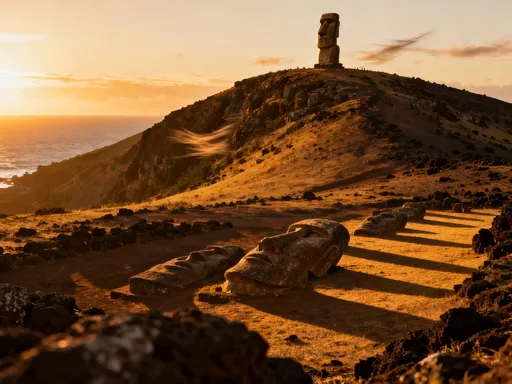
Another key location, Rano Raraku, serves as both quarry and gallery. This volcanic crater was the birthplace of most moai, where hundreds were carved directly into the rock face. Today, visitors walk among statues in various stages of completion—some half-buried, others upright, many still attached to the hillside. The effect is surreal, like stepping into a sculptor’s workshop frozen in time. This site exemplifies how the island itself became a living studio, where art and geology were inseparable. The porous tuff of Rano Raraku was ideal for carving, allowing artisans to shape intricate features with stone tools. The result was a landscape where creation and environment were in constant dialogue.
Moai: More Than Giant Heads
The moai are often misunderstood as mere giant heads emerging from the earth. In reality, they are full-body statues, many buried up to their shoulders by centuries of sediment accumulation. Archaeological excavations have revealed torsos, arms, and hands folded across abdomens, confirming that these figures were always intended to be seen in their complete form. Their proportions—elongated heads, strong brows, prominent chins—reflect a distinct Polynesian aesthetic, one that emphasized lineage, strength, and spiritual authority. These were not gods, as some assume, but representations of deified ancestors, believed to hold mana, or spiritual power, protecting the living.
Each moai was carved to honor a specific chief or elder, serving as a physical conduit between the human and spiritual realms. The most elaborate statues were adorned with pukao, cylindrical red scoria hats quarried from Puna Pau, another volcanic site. These crowns may symbolize hair buns or topknots, a sign of high status. The contrast of the red stone against the gray tuff creates a striking visual hierarchy, drawing the eye upward as if to emphasize the figure’s elevated role. Some moai also once had inlaid eyes—coral and obsidian—adding a lifelike presence that would have been especially powerful during ceremonies.
The process of carving and moving these statues remains one of archaeology’s most compelling puzzles. Weighing up to 82 tons and standing as tall as 33 feet, the moai were shaped using basalt tools called toki. Once completed, they were transported from Rano Raraku to coastal platforms, sometimes over distances of several miles. Theories suggest they were moved in an upright position, “walking” them with ropes and coordinated rocking motions—a method supported by experimental archaeology. Whether this was the exact technique or not, the feat speaks to collective effort, engineering ingenuity, and deep cultural commitment. The moai were not just art; they were acts of faith, identity, and communal endurance.
Rock Carvings and Hidden Canvases
Beyond the moai, Rapa Nui’s artistic legacy extends into thousands of petroglyphs etched into volcanic rock across the island. These carvings, often overlooked by casual visitors, offer a more intimate glimpse into the spiritual life of the Rapa Nui people. One of the most significant sites is Orongo, a ceremonial village perched on the rim of the Rano Kau crater. Here, the stone walls are covered in intricate glyphs depicting the birdman cult—a central religious tradition that emerged after the decline of moai construction. The most common motif is the tangata manu, or birdman, a figure with a human body and bird head, symbolizing a sacred competition that determined leadership for the year.
The petroglyphs at Orongo vary in depth and detail, some deeply carved and well-preserved, others faint from centuries of wind and rain. Their placement is deliberate—many are aligned with the solstice sun or face the islet of Motu Nui, where competitors would swim to retrieve the first sooty tern egg of the season. This ritual was not merely sport; it was a spiritual act, a way of renewing cosmic order and ensuring prosperity. The carvings served as both records and invocations, reinforcing the sacredness of the site. Visitors today are asked to refrain from touching the stones, as oils from human skin can accelerate erosion. The silence of Orongo, broken only by the wind and distant waves, invites contemplation rather than commentary.
Other petroglyph sites, such as those near Anakena Beach or along the coastal trails, feature symbols of creation deities like Make-make, the god of fertility and the birdman cult. There are also carvings of turtles, whales, and canoes—images tied to navigation, survival, and the ocean’s bounty. These motifs suggest a worldview deeply connected to nature, where art was not separate from daily life but woven into it. The textures of the rock itself—rough, porous, sometimes glassy from ancient lava flows—add another layer of meaning. Each carving bears the marks of time, yet their persistence is a testament to the resilience of cultural memory.
Contemporary Art Meets Ancient Tradition
While the ancient carvings draw global attention, the artistic spirit of Rapa Nui is far from frozen in the past. Today, local artists continue to express their heritage through evolving forms, blending ancestral symbols with modern techniques. Wood carving remains a vital tradition, with artisans crafting moai, birdmen, and ceremonial paddles from toromiro and miro wood. These pieces are not replicas for tourists but meaningful expressions of identity, often used in family rituals or community events. The craftsmanship reflects generations of knowledge, passed down through apprenticeships and family workshops.
Tapa cloth painting is another living art form. Made from the bark of the paper mulberry tree, tapa is beaten into thin sheets and decorated with natural dyes. Designs often echo petroglyph motifs—stylized faces, birds, and waves—linking contemporary work to ancient visual language. Some artists incorporate tapa into mixed-media installations, displaying them in community centers or during cultural festivals like Tapati Rapa Nui, a two-week celebration of music, dance, and traditional competitions. These events are not performances for outsiders but affirmations of Rapa Nui identity, where art and life remain deeply intertwined.
Dance, too, is a dynamic form of artistic expression. The traditional dance, or 'ue, combines rhythmic movement, chanting, and costume to tell stories of origin, migration, and spiritual belief. Women wear woven skirts and flower crowns, while men perform vigorous steps that mimic bird movements or warrior stances. The dances are taught in schools and performed at ceremonies, ensuring that younger generations remain connected to their cultural roots. This continuity is not about preserving the past in amber but allowing it to grow, adapt, and remain relevant in a changing world.
How the Landscape Shapes the Art
The geology of Rapa Nui is inseparable from its art. The island was formed by three extinct volcanoes—Terevaka, Poike, and Rano Kau—whose eruptions created the raw materials that would define its artistic legacy. The soft volcanic tuff of Rano Raraku was perfect for carving, allowing sculptors to shape detailed faces and bodies with relative ease. The harder basalt and red scoria were reserved for tools and ceremonial elements, adding texture and contrast. Even the island’s isolation—over 2,000 miles from the nearest inhabited land—shaped the uniqueness of its art. With limited resources and no outside influence for centuries, Rapa Nui culture developed a distinct visual language, one that spoke entirely to its own people.
The environment continues to influence how visitors experience the art. At sunrise, the moai at Ahu Tongariki are bathed in golden light, their shadows stretching long across the platform. In the late afternoon, the sea crashes against the coastal ahus, sending spray into the air like a natural offering. On cloudy days, the statues appear ghostly, half-hidden in mist, as if emerging from another time. These moments are not just scenic—they are integral to the emotional impact of the site. The art was never meant to be seen under artificial light or behind barriers. It belongs to the wind, the rain, the sun, and the sea. To walk among the moai is to move through a landscape that is both ancient and alive.
Even the island’s vegetation tells a story. Once covered in palm forests, Rapa Nui experienced significant deforestation, likely due to human activity and the introduction of rats. Today, reforestation efforts are underway, with native species being replanted to restore ecological balance. This environmental recovery parallels cultural revitalization—both are acts of healing. The art of Rapa Nui, carved in stone and sustained through memory, reminds us that creativity can endure even in the face of hardship. It is a lesson in resilience, born from the very earth.
Visitor Experience: Moving Through the Art Space
Traveling through Rapa Nui is not like visiting a typical tourist destination. There are no large resorts or crowded streets. The island has a population of around 7,000, most of whom are of Rapa Nui descent. Visitors are encouraged to approach the island with humility and awareness. Guided tours led by local narrators offer the most meaningful way to understand the sites. These guides share not just facts but family stories, oral histories, and cultural perspectives that cannot be found in guidebooks. Walking trails connect major sites, allowing for a slower, more reflective pace. The path from Rano Raraku to Tongariki, for example, follows an ancient road once used to transport moai, turning the journey itself into an act of connection.
The best times to visit are early morning or late afternoon, when light enhances the statues’ features and crowds are minimal. Midday sun can be harsh, and summer months bring more tourists, so planning ahead is wise. Accommodations range from family-run guesthouses to eco-lodges, many emphasizing sustainability and cultural respect. Dining options include local seafood, sweet potatoes, and traditional dishes like umu, a feast cooked in an earth oven. These experiences, when approached with openness, deepen the sense of place.
Preservation is a shared responsibility. Visitors are asked not to climb on the moai or petroglyphs, to stay on marked paths, and to avoid removing any stones or artifacts. These rules are not arbitrary; they protect fragile sites from irreversible damage. The Rapa Nui people have fought for decades to regain control over their cultural heritage, and tourism must support, not exploit, that legacy. By listening, learning, and moving gently through the landscape, travelers become part of a respectful dialogue—one that honors the past while safeguarding the future.
Why This Art Space Matters Today
Easter Island’s artistic legacy is more than a collection of ancient carvings. It is a profound statement about human creativity, resilience, and the enduring need to leave a mark. In an age of digital reproduction and fleeting trends, Rapa Nui offers something rare: art that is rooted, permanent, and spiritually grounded. The moai do not advertise or entertain; they witness. They remind us that culture is not just what we consume but what we create, protect, and pass on. Their silent presence challenges modern assumptions about progress, urging us to consider what truly lasts.
The island’s isolation, once a barrier, now makes it a mirror for the world. How do societies sustain themselves? How do we balance ambition with environmental limits? How do we honor ancestors while building for the future? These questions resonate far beyond the Pacific. The art of Rapa Nui is not a relic but a living conversation—one that invites reflection, empathy, and responsibility. When we visit, we are not just spectators. We are guests in a sacred space, entrusted with the duty to see deeply, listen closely, and leave lightly.
Ultimately, Easter Island teaches that art is not confined to galleries or museums. It can be the shape of a mountain, the curve of a coastline, the silence between statues. It can be a people’s memory carved in stone, a dance passed from mother to daughter, a song carried on the wind. To experience Rapa Nui is to understand that the most powerful art is not made to be owned, but to be felt. And in feeling it, we become part of its story—a story that continues, one respectful step at a time.